Cover letter in German: the layout conventions for Germany
A cover letter for a job in Germany follows a recognisable layout, from the sender's address block to the handwritten signature. Here are the five conventions Fayna's default letter layout for Germany follows.
What a cover letter in German looks like
If you are writing a cover letter in German, or any cover letter for a job in Germany, its layout follows a few clear conventions.
A German cover letter has:
- the sender's address block: your own address, set out as the sender;
- a date line with the day, month and year in numbers, separated by dots;
- a bold subject line;
- an enclosure line;
- a handwritten signature, which is expected.
The sections below take each one in turn. Fayna's default letter layout for this market follows all five.
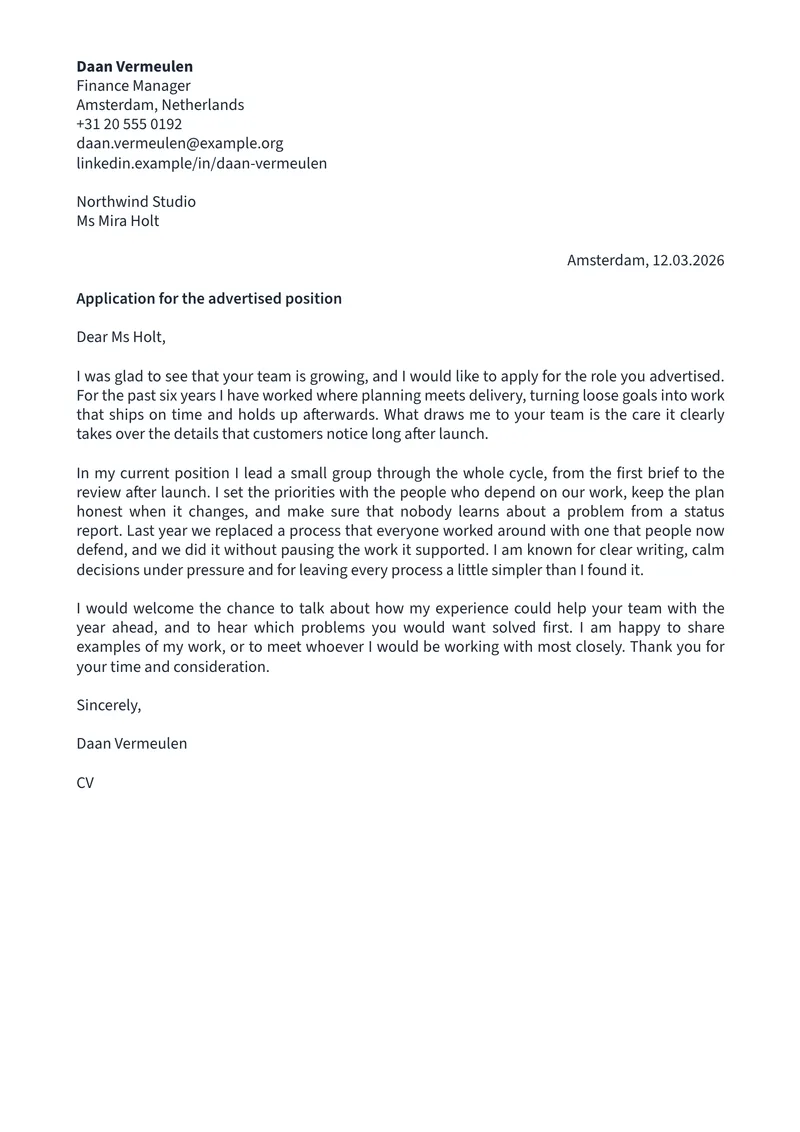
The layout Fayna applies for Germany
- Address block
Fayna applies this by default
- NumericExample: Berlin, 23.09.2026
Fayna applies this by default
- Bold
Fayna applies this by default
- ListedExample: Anlagen
Fayna applies this by default
- Expected
Fayna applies this by default
The five conventions, line by line
The sender's address block
The letter carries your address block as the sender. Fayna's default letter layout for Germany includes it.
The date line
The date is written as day, month and year in numbers, separated by dots. A typical line reads:
Berlin, 23.09.2026
Fayna's default letter layout for Germany writes the date this way.
A bold subject line
The letter has a subject line, set in bold, so the reader sees at once what the letter is about. Fayna's default letter layout for Germany follows this.
The enclosure line
The letter ends with an enclosure line. In German it reads:
Anlagen
Fayna's default letter layout for Germany includes this line.
A handwritten signature
A handwritten signature is expected on a German cover letter; in a letter you email or upload, it is usually a scanned image. Fayna's default letter layout for Germany follows this convention.
Where Germany's conventions are set in Fayna
In the editor, a cover letter's context settings list the layout conventions first, above the language and the tone. With Germany's conventions in place, the default letter layout follows the five points above: sender's address block, numeric date with dots, bold subject line, enclosure line and handwritten signature.
To see the designs, browse the cover letter templates. If you are preparing the CV that goes with the letter, the CV templates are the place to start, and the cover letter builder explains how the letter editor works.
Sources
The layout conventions on this page follow public guidance for people applying to German employers:
- JGU Career Service: Cover letter: Johannes Gutenberg University Mainz: a cover letter for a German employer follows the business-letter standard DIN 5008, with your contact details, the employer's address, a subject line, your signature as a scanned image, and one page.
- Make it in Germany: Applying for a job: the German federal government's portal for skilled workers: what a cover letter for a German employer should say, and the documents an application usually includes.
The date format and the enclosure line are the defaults of Fayna's letter layout for Germany, listed in the facts block on this page.
The matching CV
Questions about German cover letters
As day, month and year in numbers, separated by dots, for example "Berlin, 23.09.2026". Fayna's default letter layout for Germany writes the date this way.
It is a line near the end of the letter marking the enclosures, written as "Anlagen" in German. Fayna's default letter layout for Germany includes it.
Yes, a handwritten signature is expected. Fayna's default letter layout for Germany follows this convention.
Yes. A German cover letter has a bold subject line, and Fayna's default letter layout for Germany sets it that way.
Yes. The sender's address block is part of a German cover letter, and Fayna's default letter layout for Germany includes it.
No. This page covers the layout conventions of a cover letter for Germany: the sender's address block, the date line, the bold subject line, the enclosure line and the handwritten signature.